Page text searchable · extracted from the PDF
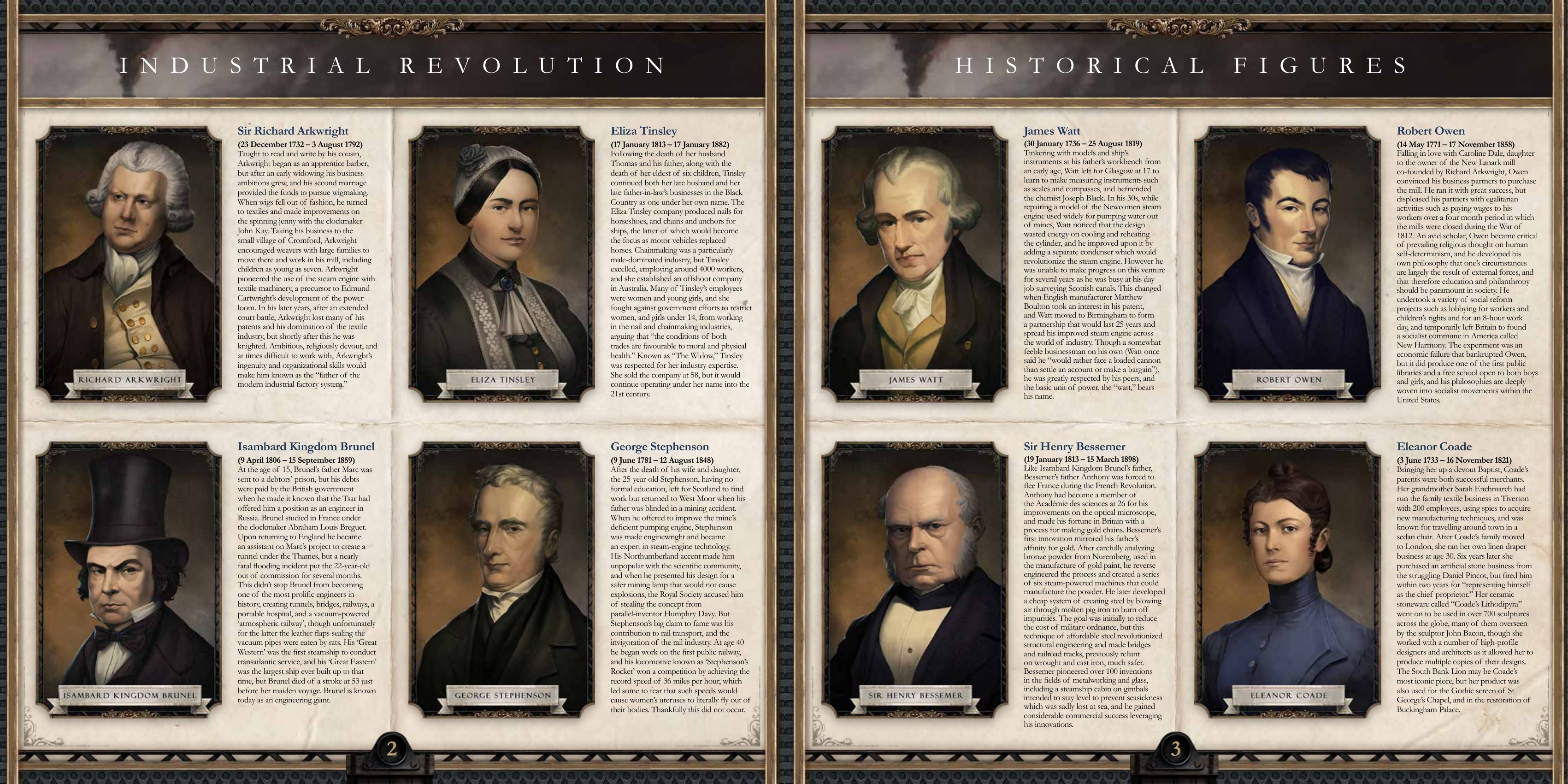
Sir Richard Arkwright
(23 December 1732 – 3 August 1792)
Taught to read and write by his cousin,
Arkwright began as an apprentice barber,
but after an early widowing his business
ambitions grew, and his second marriage
provided the funds to pursue wigmaking.
When wigs fell out of fashion, he turned
to textiles and made improvements on
the spinning jenny with the clockmaker
John Kay. Taking his business to the
small village of Cromford, Arkwright
encouraged weavers with large families to
move there and work in his mill, including
children as young as seven. Arkwright
pioneered the use of the steam engine with
textile machinery, a precursor to Edmund
Cartwright’s development of the power
loom. In his later years, after an extended
court battle, Arkwright lost many of his
patents and his domination of the textile
industry, but shortly after this he was
knighted. Ambitious, religiously devout, and
at times difficult to work with, Arkwright’s
ingenuity and organizational skills would
make him known as the “father of the
modern industrial factory system.”
James Watt
(30 January 1736 – 25 August 1819)
Tinkering with models and ship’s
instruments at his father’s workbench from
an early age, Watt left for Glasgow at 17 to
learn to make measuring instruments such
as scales and compasses, and befriended
the chemist Joseph Black. In his 30s, while
repairing a model of the Newcomen steam
engine used widely for pumping water out
of mines, Watt noticed that the design
wasted energy on cooling and reheating
the cylinder, and he improved upon it by
adding a separate condenser which would
revolutionize the steam engine. However he
was unable to make progress on this venture
for several years as he was busy at his day
job surveying Scottish canals. This changed
when English manufacturer Matthew
Boulton took an interest in his patent,
and Watt moved to Birmingham to form
a partnership that would last 25 years and
spread his improved steam engine across
the world of industry. Though a somewhat
feeble businessman on his own (Watt once
said he “would rather face a loaded cannon
than settle an account or make a bargain”),
he was greatly respected by his peers, and
the basic unit of power, the “watt,” bears
his name.
Isambard Kingdom Brunel
(9 April 1806 – 15 September 1859)
At the age of 15, Brunel’s father Marc was
sent to a debtors’ prison, but his debts
were paid by the British government
when he made it known that the Tsar had
offered him a position as an engineer in
Russia. Brunel studied in France under
the clockmaker Abraham Louis Breguet.
Upon returning to England he became
an assistant on Marc’s project to create a
tunnel under the Thames, but a nearly-
fatal flooding incident put the 22-year-old
out of commission for several months.
This didn’t stop Brunel from becoming
one of the most prolific engineers in
history, creating tunnels, bridges, railways, a
portable hospital, and a vacuum-powered
‘atmospheric railway’, though unfortunately
for the latter the leather flaps sealing the
vacuum pipes were eaten by rats. His ‘Great
Western’ was the first steamship to conduct
transatlantic service, and his ‘Great Eastern’
was the largest ship ever built up to that
time, but Brunel died of a stroke at 53 just
before her maiden voyage. Brunel is known
today as an engineering giant.
Sir Henry Bessemer
(19 January 1813 – 15 March 1898)
Like Isambard Kingdom Brunel’s father,
Bessemer’s father Anthony was forced to
flee France during the French Revolution.
Anthony had become a member of
the Académie des sciences at 26 for his
improvements on the optical microscope,
and made his fortune in Britain with a
process for making gold chains. Bessemer’s
first innovation mirrored his father’s
affinity for gold. After carefully analyzing
bronze powder from Nuremberg, used in
the manufacture of gold paint, he reverse
engineered the process and created a series
of six steam-powered machines that could
manufacture the powder. He later developed
a cheap system of creating steel by blowing
air through molten pig iron to burn off
impurities. The goal was initially to reduce
the cost of military ordnance, but this
technique of affordable steel revolutionized
structural engineering and made bridges
and railroad tracks, previously reliant
on wrought and cast iron, much safer.
Bessemer pioneered over 100 inventions
in the fields of metalworking and glass,
including a steamship cabin on gimbals
intended to stay level to prevent seasickness
which was sadly lost at sea, and he gained
considerable commercial success leveraging
his innovations.
Eliza Tinsley
(17 January 1813 – 17 January 1882)
Following the death of her husband
Thomas and his father, along with the
death of her eldest of six children, Tinsley
continued both her late husband and her
late father-in-law’s businesses in the Black
Country as one under her own name. The
Eliza Tinsley company produced nails for
horseshoes, and chains and anchors for
ships, the latter of which would become
the focus as motor vehicles replaced
horses. Chainmaking was a particularly
male-dominated industry, but Tinsley
excelled, employing around 4000 workers,
and she established an offshoot company
in Australia. Many of Tinsley’s employees
were women and young girls, and she
fought against government efforts to restrict
women, and girls under 14, from working
in the nail and chainmaking industries,
arguing that “the conditions of both
trades are favourable to moral and physical
health.” Known as “The Widow,” Tinsley
was respected for her industry expertise.
She sold the company at 58, but it would
continue operating under her name into the
21st century.
Robert Owen
(14 May 1771 – 17 November 1858)
Falling in love with Caroline Dale, daughter
to the owner of the New Lanark mill
co-founded by Richard Arkwright, Owen
convinced his business partners to purchase
the mill. He ran it with great success, but
displeased his partners with egalitarian
activities such as paying wages to his
workers over a four month period in which
the mills were closed during the War of
1812. An avid scholar, Owen became critical
of prevailing religious thought on human
self-determinism, and he developed his
own philosophy that one’s circumstances
are largely the result of external forces, and
that therefore education and philanthropy
should be paramount in society. He
undertook a variety of social reform
projects such as lobbying for workers and
children’s rights and for an 8-hour work
day, and temporarily left Britain to found
a socialist commune in America called
New Harmony. The experiment was an
economic failure that bankrupted Owen,
but it did produce one of the first public
libraries and a free school open to both boys
and girls, and his philosophies are deeply
woven into socialist movements within the
United States.
George Stephenson
(9 June 1781 – 12 August 1848)
After the death of his wife and daughter,
the 25-year-old Stephenson, having no
formal education, left for Scotland to find
work but returned to West Moor when his
father was blinded in a mining accident.
When he offered to improve the mine’s
deficient pumping engine, Stephenson
was made enginewright and became
an expert in steam-engine technology.
His Northumberland accent made him
unpopular with the scientific community,
and when he presented his design for a
safer mining lamp that would not cause
explosions, the Royal Society accused him
of stealing the concept from
parallel-inventor Humphry Davy. But
Stephenson’s big claim to fame was his
contribution to rail transport, and the
invigoration of the rail industry. At age 40
he began work on the first public railway,
and his locomotive known as ‘Stephenson’s
Rocket’ won a competition by achieving the
record speed of 36 miles per hour, which
led some to fear that such speeds would
cause women’s uteruses to literally fly out of
their bodies. Thankfully this did not occur.
Eleanor Coade
(3 June 1733 – 16 November 1821)
Bringing her up a devout Baptist, Coade’s
parents were both successful merchants.
Her grandmother Sarah Enchmarch had
run the family textile business in Tiverton
with 200 employees, using spies to acquire
new manufacturing techniques, and was
known for travelling around town in a
sedan chair. After Coade’s family moved
to London, she ran her own linen draper
business at age 30. Six years later she
purchased an artificial stone business from
the struggling Daniel Pincot, but fired him
within two years for “representing himself
as the chief proprietor.” Her ceramic
stoneware called “Coade’s Lithodipyra”
went on to be used in over 700 sculptures
across the globe, many of them overseen
by the sculptor John Bacon, though she
worked with a number of high-profile
designers and architects as it allowed her to
produce multiple copies of their designs.
The South Bank Lion may be Coade’s
most iconic piece, but her product was
also used for the Gothic screen of St
George’s Chapel, and in the restoration of
Buckingham Palace.
I N D U S T R I A L R E V O L U T I O N H I S T O R I C A L F I G U R E S
3 2